
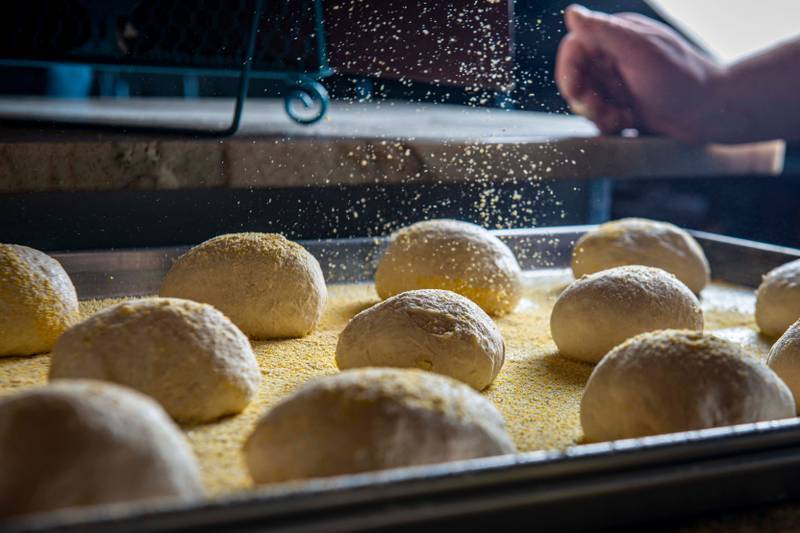
If you’ve ever switched from store-bought flour to freshly milled flour and thought, “Why does my dough feel different?”—you’re not imagining it.
Fresh-milled flour can behave differently from conventional flour in everything from hydration to fermentation. And that’s part of what makes baking with freshly milled whole grains so rewarding.
At Kern River Milling, we stone-grind our grains to order rather than letting flour sit on a shelf for months before it reaches your kitchen. That simple difference can change the way you bake.
Fresh Flour Starts With the Whole Grain
When a grain of wheat is milled, you’re breaking open the entire kernel—bran, germ, and endosperm.
The bran provides much of the grain’s fiber and minerals. The germ contains naturally occurring oils and nutrients. The endosperm provides much of the starch that gives bread its structure.
Traditional commercial flour is often processed and stored for extended periods. Fresh-milled flour takes a different approach: mill the grain, package the flour, and get it into the hands of the baker.
That means when you open a bag of Kern River Milling flour, you’re working with flour that was milled with freshness in mind.
Why Fresh-Milled Flour Can Absorb More Water
One of the first things many bakers notice is that fresh-milled whole grain flour can be thirsty.
The bran and germ can absorb a significant amount of water, so a dough that looks perfect with conventional flour may feel noticeably firmer when you first make the switch.
Instead of immediately adding large amounts of water, try giving your dough some time to hydrate.
A short rest can allow the flour to absorb the water more completely before you decide whether the dough actually needs more.
This is especially useful when working with freshly milled wheat because every grain and milling process can behave a little differently.
Your Dough May Need a Different Approach
Fresh-milled flour isn’t necessarily a one-for-one substitute in your favorite recipe.
You may notice differences in:
- Hydration
- Dough texture
- Fermentation speed
- Gluten development
- Loaf volume
- Flavor and aroma
That doesn’t mean fresh-milled flour is harder to bake with. It simply means you’re working with a flour that hasn’t been treated like a commodity sitting on a grocery-store shelf.
Once you learn how your particular flour behaves, the process becomes much more intuitive.
The Flavor Is Part of the Experience
One of our favorite reasons to mill fresh is flavor.
Freshly milled whole grains can bring a depth and aroma to bread that is difficult to describe until you’ve baked with them yourself. Depending on the grain, you may notice nuttier, sweeter, earthier, or more complex flavors.
That flavor is especially noticeable in simple recipes where the grain itself has nowhere to hide.
A loaf made with freshly milled Einkorn, for example, has a character all its own.
Why We Mill to Order at Kern River Milling
This is one of the biggest differences between what we do and simply buying a bag of flour off a grocery-store shelf.
We aren’t interested in producing flour as quickly as possible and letting it sit around.
We started Kern River Milling because we wanted to make high-quality, freshly milled flour more accessible to home bakers.
Our flour is stone-ground to order, using whole grains selected for baking. We also focus on sourcing that aligns with what our customers are looking for, including Non-GMO and glyphosate-free grains.
From our mill in Bakersfield, California, we package the flour and ship it directly to customers across the country.
The goal is simple: mill the grain, preserve what makes it special, and get it to your kitchen fresh.
Give Your Flour Time to Become Part of Your Process
If you’re new to fresh-milled flour, don’t worry if your first loaf isn’t perfect.
Start with one recipe you already know. Pay attention to the dough instead of relying entirely on the measurements. Notice how much water it absorbs, how quickly it ferments, and how the finished loaf tastes.
Then adjust from there.
That’s part of the fun of milling your own flour—or using flour that was freshly milled for you.
You’re not just following a recipe anymore. You’re learning how the grain behaves.
And once you taste the difference, it’s hard to look at flour the same way again.
Ready to Try Fresh-Milled Flour?
Kern River Milling offers freshly milled whole grain flour, including Einkorn and other wheat varieties, in convenient sizes for home bakers.
Stone-ground to order. Non-GMO. Glyphosate free. Milled fresh in Bakersfield, California.
Bring the freshness of the mill into your own kitchen.