
The Rise of Shelf-Stable Flour
During the Industrial Revolution, millers discovered something big: By removing the bran and germ, flour could last months or years instead of days. This stripped-down “white flour” was soft, easy to ship, and perfect for mass production. It wasn’t long before this new flour became the standard. It filled shelves, storage bins, and factories—clean, white, and shelf-stable.
Local Mills Shut Down
As the demand for white flour soared, small-town mills—once the heart of many communities—closed. Hand-milled flour became a thing of the past. Hearty, nourishing loaves gave way to dainty, white bread that prioritized texture over nutrition. We lost more than the grain. We lost rhythm, tradition, and the local connection between people and their food.
The White Bread Craze
By the early 1900s, white bread had become a status symbol. Its snowy texture was prized in baking—and it quietly signaled wealth, refinement, and modernity. But that texture came at a cost: the loss of essential nutrients. Fiber, vitamin E, healthy fats, and dozens of micronutrients were nowhere to be found.
People Got Sick
Without the bran and germ, diets lost a critical source of nutrients—especially niacin. This led to pellagra, a serious disease caused by niacin deficiency. By the 1920s, thousands of Americans—particularly in poorer communities—became ill. Bread was still a staple. But it no longer nourished.
Enter: Enriched Flour
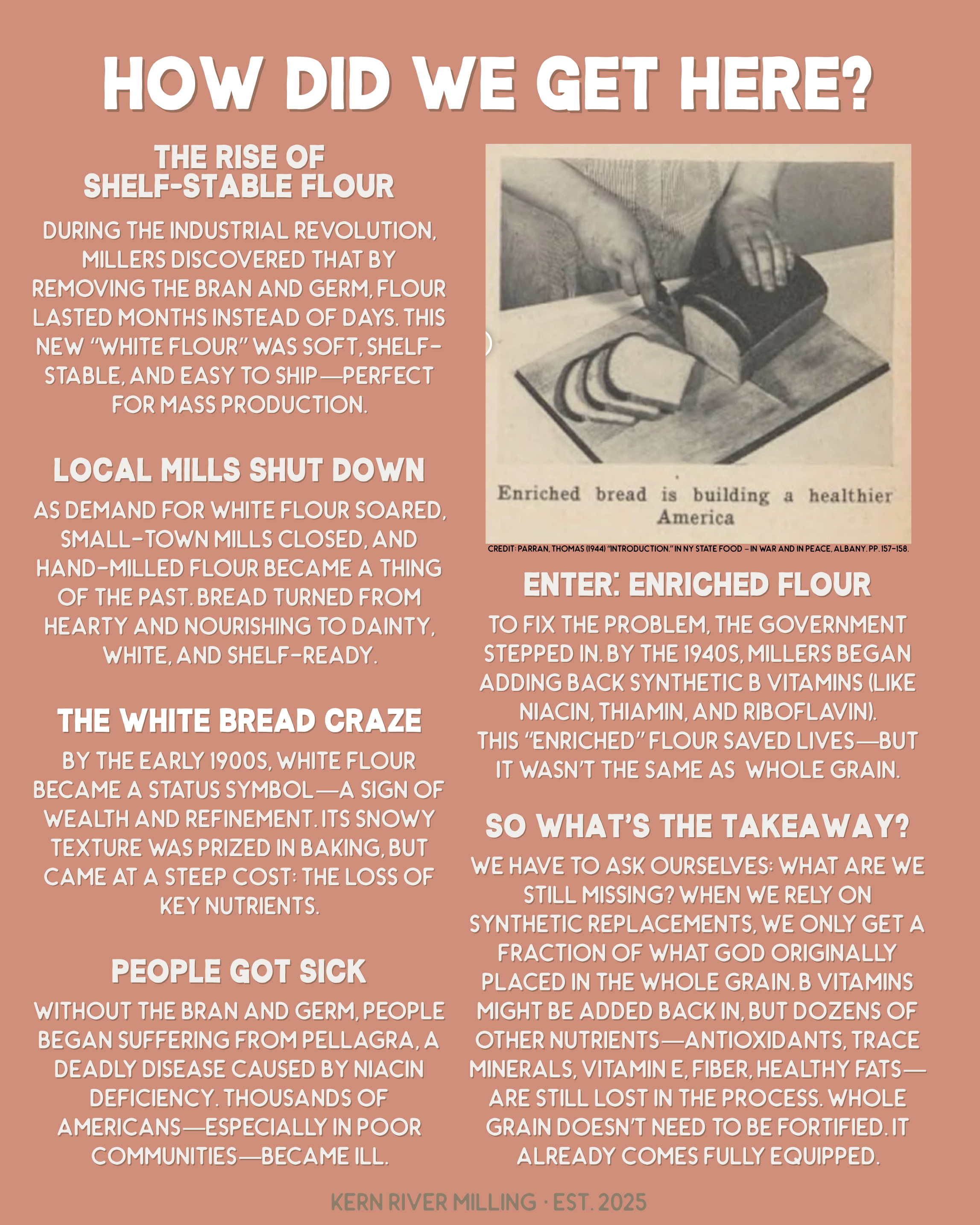
In the 1940s, the government stepped in. Millers began “enriching” white flour by adding back synthetic B vitamins like niacin, thiamin, and riboflavin. These additions helped prevent deficiency diseases—and yes, they saved lives. But it still wasn’t the same as true whole grain. We were getting a few nutrients back, but not the full package the wheat berry was designed to deliver.
So What’s the Takeaway?
When we rely on synthetic replacements, we only get a fraction of what the whole grain offers. Even enriched flour lacks the antioxidants, trace minerals, vitamin E, fiber, and healthy fats that are naturally present in whole grain.
Whole grain doesn’t need to be fortified. It already comes fully equipped.